 |
"How the Chicken Evolved" - By "M" & "C", Grade 7 |
CBMS Choice-Based Art Studio

CBMS Choice-Based Art Studio
Wednesday, April 4, 2018
Tuesday, January 30, 2018
The Art Locker

Step right up and view the Art Locker!

I hope I haven't blown their cover - but look! It's a delight!


Thursday, December 7, 2017
Art Trap
There has been some interest (by alert art teachers) in the idea of Art Traps - here is one I set just now to prepare for the afternoon's 6th grade class.
 |
| "Watercolor" paint made from soaking old, used up watercolor markers |
I think of an art trap as an invitation - "Come, try this out -it's all ready for you." I set the table with care, trying to think of helpful details (in this case, taping paper to boards and providing the correct brushes for watercolor painting.)
The idea is to temp learners to try something they might not have thought of otherwise, to nudge them into sampling a new media or tool, to bypass the decision-making, or set-up, that might prevent some from getting down to it. It's about removing barriers - sparking interest.
Now I wait and see if anyone falls in to my trap.
UPDATE:
I just realized that the watercolor trap (above) is the second trap I have set today - I set the one below in the hall outside the art studio when I got to school, and have caught quite a few passers-by already.

After the loom was in the hall for a few days, two weavers started to make a "bride and Groom", then a "flower girl" and today - a "Mermaid Goddess"! (See below)
 |
| "Bride & Groom" at right, "FlowerGirl in center (pink hat), "Mermaid Goddess far left" |
Friday, November 3, 2017
Homework
 |
| "C" at work on a project started with a friend "a year or two ago" in his 5th or 6th grade classroom |


 |
| These images are copyrighted and appear to be part of a parent company called "The Ba News Company" |


UPDATE:
"C" told me he use to work with a partner making comics - they reunited this year near the end of he term, when "W" brought his folder in to show me.


Good Stuff! I'm so glad these two have kept this work and that it continues to grow with them. (Thanks "W" and "C" for sharing this).
Thursday, October 19, 2017
Interactive Art
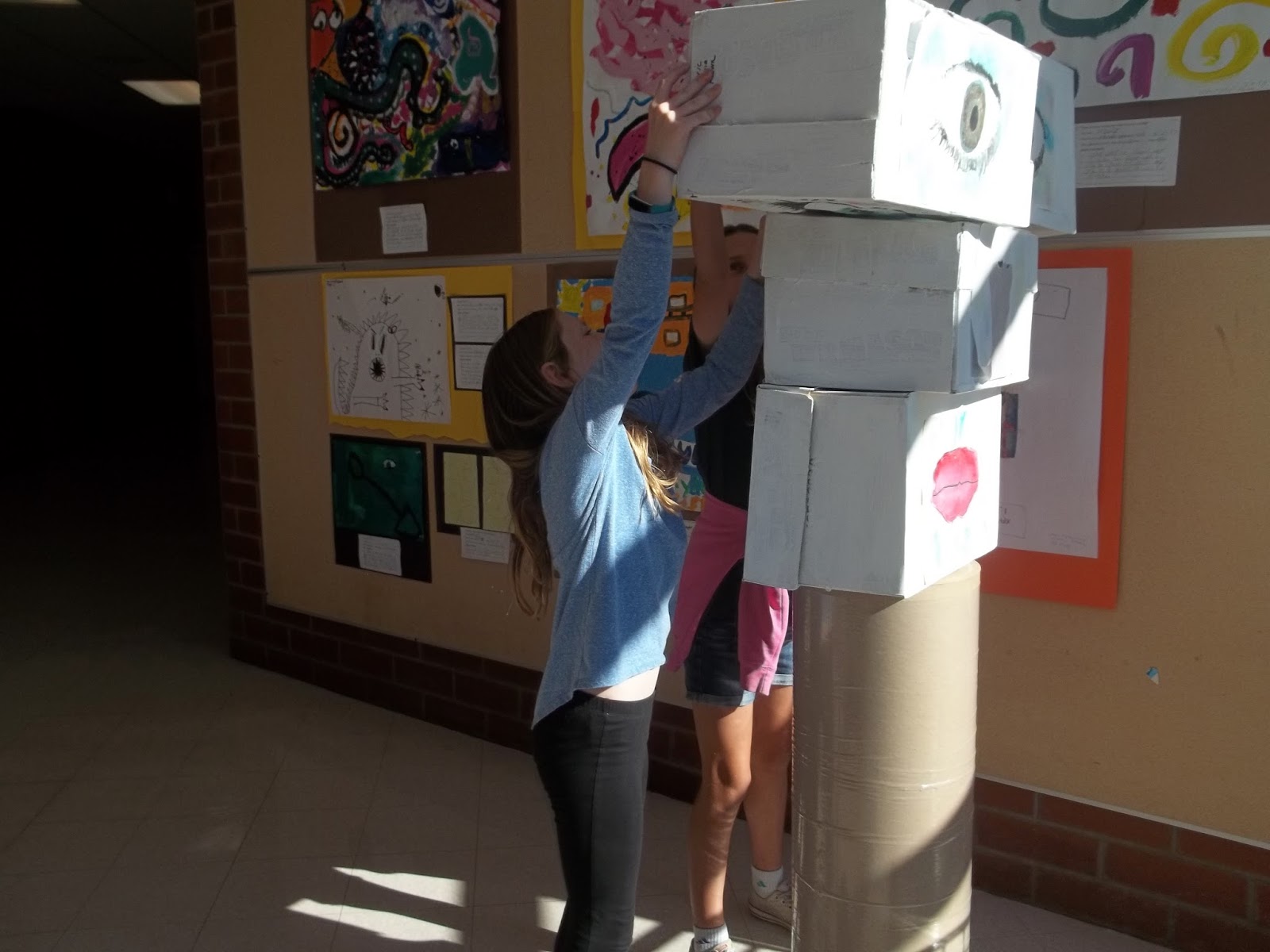
This scrambled-face sculpture was created by a group of three 7th grade students, in response to a prompt to "use the human face or figure in an artwork."
 They tell me the idea came from an online search. The result is a sculpture that invites viewers to arrange, and re-arrange, the components, for an ever-changing viewing experience.
 I noticed that the sculpture was static for about two weeks before it started to get altered by passers-by.


Now that our learning community has caught on to the possibilities, the sculpture is rearranged several times a day!
 Congratulations sculptors, for engaging our school community with your artwork!


Animals as Models

Where's my camera!
Animal week emerged in the art studio this week, but I keep forgetting to take pictures! It's pretty exciting having a chicken hanging out on a table in the studio, or a praying mantis clinging to a clay pear...I guess it makes me forget to reach for my camera when I am helping to keep our subject from escape!


I missed photos of Tuesday's chicken visitor, "Siesta", who is a very patient model, and neglected to snap a shot of yesterday's praying mantis (Chinese mantis, to be precise) -at least I remembered to take a picture of "Daisy," the Russian tortoise who tolerated a make-shift block fortress-enclosure.
 The chickens live out in the school yard, and are an itergral part of the Sustainability program. The praying mantis is a beloved pet of a sixth-grader who knows just about everything about raising manti. Daisy lives in a 5th/6th grade classroom on the "Wizards"wing.
This revolving-door menagerie is a result of student interest and initiative, not my planning or procurement.
We are in the second week of "Drawing Boot Camp" which meets for a half-hour "iblock" each day. Student-directed learning is evident in the initiative taken by this group of young artists.
iblock is the perfect place to for drawing practice. In this setting, the focused attention drawing takes does not have to compete with all the other options available during regular studio-time.
I'm hoping "Brian," the bearded lizard, shows up tomorrow.
 |
(Brian came through!) |
Monday, September 18, 2017
How to Draw a Face
By 7th grade, art students usually start to show me that they are really struggling to make their people "look real." That is my signal to teach about "correct" proportions. I put correct in quotes, because as I teach about where things are placed anatomically, I stress that my lesson is not intended to tell students "how to make a face." There are as many ways to do that as there are artists. The same goes with the "correct proportions" of a human figure.

For some, this information is useful, for others, less so. And that got me thinking - It might be interesting for students, and help drive home my point, if they saw a variety of approaches used by artists to depict a human face or figure. Here is what greeted students the next day:


The following day, I swapped out the word "Realistic" for Realism, "Less Real" became Impressionism or Expressionism, and "Not Real" became Abstract. (Using abstract in this context helped to convey the information that "abstract" is artwork based on a subject, as opposed to "non-objective, or "non-subjective" artwork, which is not.
 (I also pulled out a lot of drawing books for students to use for more information, or for those interested in going deeper or practicing.)
 I am curious to see how, when, where, or if, students use the information shared over the last few days in their own work going forward.

For some, this information is useful, for others, less so. And that got me thinking - It might be interesting for students, and help drive home my point, if they saw a variety of approaches used by artists to depict a human face or figure. Here is what greeted students the next day:

This sorting game is one I learned from Professor John Crowe, at the Summer Teaching for Artistic Behavior Institute in Boston. We later agreed to change the categories to "Realistic," "Less Realistic," and "Not Realistic," to avoid confusion (and thwart the clever ringleader who put all in images in the "real" pile, because, you know, they are all '"real" art...."


The following day, I swapped out the word "Realistic" for Realism, "Less Real" became Impressionism or Expressionism, and "Not Real" became Abstract. (Using abstract in this context helped to convey the information that "abstract" is artwork based on a subject, as opposed to "non-objective, or "non-subjective" artwork, which is not.

 |
| At work at the easel is "N," Grade 7 |

Subscribe to:
Posts (Atom)