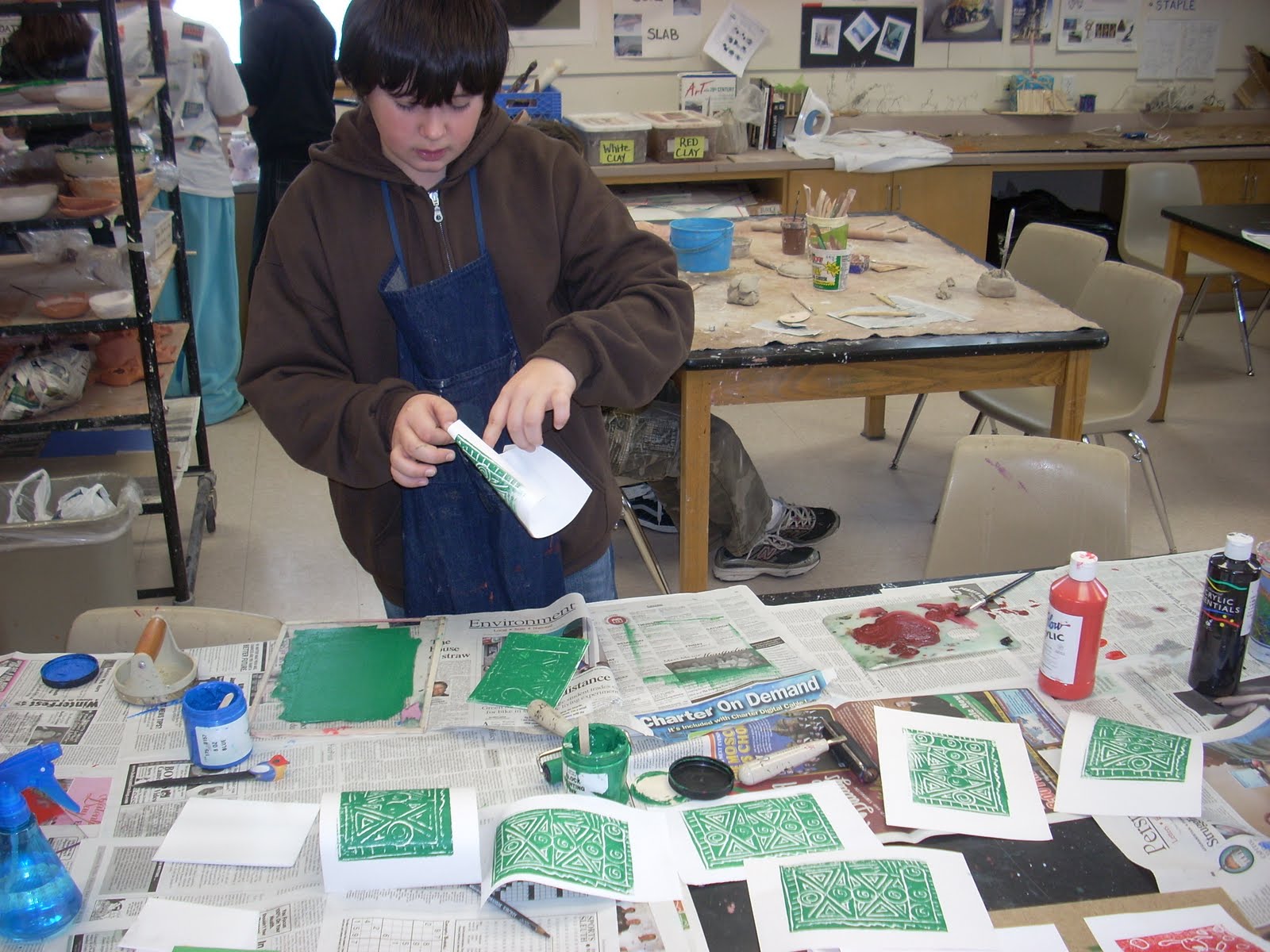
All classes are now elbow deep in the joy of clay. Most have had introductions or refreshers on hand-building techniques, and as of tomorrow, each class will have access to the two new potter's wheels we are test-driving in the studio.
At the start of school, the studio comes back to life, one studio “center” at a time. For new studio-users, this means getting instruction about what to find in each center, how to care for the tools, materials, references and resources found there, and how to clean-up.
"W" mixes colors and begins a large tempera painting
What kind of paint is there at the painting center? Can we use the big brushes? Where do I put my painting when I am done? Systems and routines are established so that the studio can run efficiently and students can function autonomously.
For students returning to the art studio from last year, there is review of expectations and a highlighting of changes. What is the same and what is new?
Watercolor sets, liquid watercolor and liquid tempera are available in the painting center. Later we will add acrylic, gouache, oil paint and India ink.
Midway through the second week of school, there are four centers up and running- Drawing, Painting, Collage and Sculpture, and one reoccurring question:When will the Clay Center open?
“Art is something you make that expresses yourself.”
On the first day of art, 2010, students were asked to respond to the question: What is Art? Answers were varied - some surprising and insightful, some intuitive and simple – but many addressed the idea of self-expression. By the third day of school, once portfolios were labeled and studio-systems were reviewed, students settled into the real work of artists; looking for inspiration, deciding on subject matter, selecting tools, locating references. Over the next few posts I will refer back to student responses to my initial question, and highlight some of the work produced in the CBMS studio which illustrates what art is, here and now, for this group of middle school artists.
Monday, August 16, 2010
A Choice Based Art Program: Studio-Learning What’s New in the Art Room?
“Art this year is going to be much more fun, because we get to do what we want and be really creative.”
The highest form of learning occurs when students are encouraged to work in the same manner as do professionals in the field –in this case learning about art in the same way as do practicing artists. Studio-learning in the CBMS art program empowers students to take greater control of their learning, to find and communicate personal meaning through art and to have the freedom to explore their own ideas and passions. By doing the real work of artists in a community studio, students learn about art as first hand inquirers and creative producers.
Our choice-based art program honors and empowers the student-as-artist, and offers authentic choices for students to respond to their own ideas and interests (Douglas, Jaquith, 2009). Students make choices about what materials to use to express their ideas, set up their materials and space, and are responsible for caring responsibly for their community studio. Students generate ideas, overcome obstacles and set-backs and may choose to work alone or with peers. Students are expected to reflect on and discuss their finished work. This is the authentic work of real artists.
The introduction of new concepts, techniques, art history, contemporary topics and multi-cultural arts are delivered in short whole-group sessions at the start of each class. Students are then invited to further investigate the new concept, or move to various other “centers” in the room to pursue their current interest.
Available “centers” are media based and contain tools, materials and instructions as well as resources and art reproductions. Instruction is differentiated – content and resources can be targeted to individuals and small groups in response to current activities and interests. Students are encouraged to evaluate their efforts, and describe their work to others.
Students have the opportunity to concentrate in one area in order to become expert with a particular material or method or they may dabble and experiment with a number of different centers, seeking inspiration from materials or processes. Students know they may repeat a process or revisit an idea, in effect working in series to produce a “suite” of related work. They understand that they may stay with their work until they are satisfied and may move on to a new challenge when they are ready to move on. The program is designed to nurture and protect qualities that lead toward inquisitive, confident, inventive, tolerant, capable human beings. Recent research in the field stresses the importance of relevance, meaning and ownership in the creative process. In the CBMS art studio, students are asked to take ownership of their ideas and products and are responsible for their work and work habits. Students are asked to consider ways to stretch and reach in their projects, finding deeper meaning, greater competence and improved skill.
- Nan
Sources: Teaching for Artistic Behavior Website: http://teachingforartisticbehavior.org/ Engaging Learners through Artmaking (2009) K. Douglas & D. Jaquith The Case for Constructivist Classrooms (2001) Jacqueline Grennon Brooks, Martin G Brooks The Art of Teaching Art to Children (2001) Nancy Beal No More Second Hand Art: Awakening the Artist Within (1989) P. London


 5th grader "H" works in the collage center