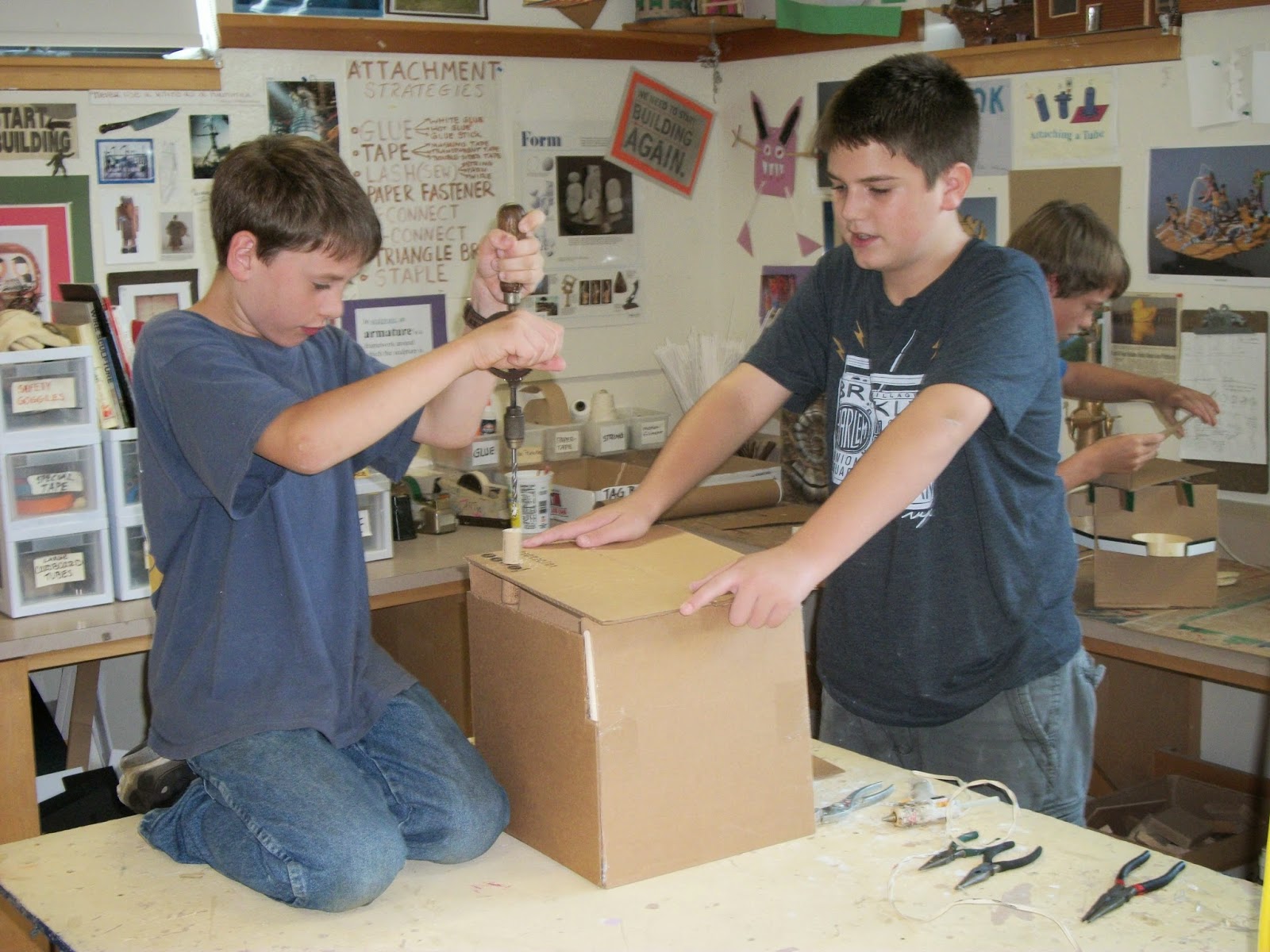
Every art teacher is grateful for material donantions for the art program. But alas, as I admitted in a previous post, I can be somewhat of a hoarder, keeping stuff that is too-good-to-use tucked away in the art closet. Well, the art closet is bursting its seams, so when we got a recent donation of a mixed array of good stuff, I decided to bypass the sorting and the storing and put it right out in the studio for immediate consumption.
I labeled the box "MYSTERY CHALLENGE" and invited students to create something using only materials from the box. I whipped up a soft-sculpture to try to drum up business, but with mixed results.
A few 6th graders made an attempt to get something going, but have since set these aside to pursue other interests.
It turns out, sewing is slow-going, and not everyone has the stick-to-it-ness to have satisfactory results.
CBMS Choice-Based Art Studio
Tuesday, September 30, 2014
Thursday, September 25, 2014
PUPPET Center Debut
| An "ephemeral center" in the studio, Puppet Making is here-today, gone-tomorrow (will likely stay up for a few weeks) |
| "I," Grade 6 is specializing in paper-bowl stick puppets. |
| "E" prefers sock puppets |
Monday, September 8, 2014
How to Handle a Cup
6th grade “K”
arrived today hoping it was her turn on the potter's wheel, because
she knew what she was going to make. She told me about a tea cup her mother bought from a friend at a yard sale (originally from Amsterdam I later learned). It had a handle that was cut from the rim. Did
you ever hear of such a thing? I never have.
![]() |
| Here is the cup that inspired "K" |
“K” was
delighted when several people ahead of her on the wheel-list declined
their turn, allowing her to get right to work. She quickly threw a
nice round cup shape and then debated whether she should cut and
attach the rim/handle right away, or wait for the clay to firm up by
covering it lightly overnight.
Not one to hesitate
long, she “went for it!”
| "K"='s" cup - ready to dry |
“K” was able to
plan for her time in the studio today before she even set foot in
class. Since tools, materials, references and resources are arranged
in studio “Centers” for student use year
round, students can rely on having what they need when they come to
work as artists in their studio. This makes possible the kind of
creative planning and idea-execution that “K” demonstrated.
And isn't this a
groovy new way to make a cup handle?
Friday, September 5, 2014
Ephemeral Centers: Bookmaking!
Two years ago, a 6th grader made a series of books right after I
opened a “Bookmaking Center.” Last year, she had no interest in
this activity, even after I set everything up hoping to entice her. Now an 8th grader, she asked: “when are
you going to open the bookmaking center?” My response? “Tomorrow”
of course!
| Temporary center occupying flex-table |
Sometimes these “ephemeral centers” pop up overnight like a flush
of mushrooms on the lawn. I try to keep one table free for this sort
of flexible use. This week, the Bookmaking Center appeared here. When
interest wanes, a new offering will take its place.
The center contains tools, materials and references of the bookmaker.
For tools we have; an awl, large needles, a bone folder, beeswax, binding clips, double-sided
tape, hole-punches, a Japanese book drill and an antique book press.
There is a box of “cover stock” (mat board and cardboard donated
from the local frame shop), a box of papers in various sizes for
pages, and another box containing my collected hand-made books which
serve as inspiration and models for possible books styles and
designs. Several books about bookmaking are there too, including
“how-to's” and a collection of amazing artist-made books.
Instead of providing “how to make a book” lessons for everyone,
interested or not, I encourage interested students to browse through
the sample books, leaf through the instructional manuals and then
engineer their own book in their own way, for their own purpose.
Today a 6th grader asked for some help binding her book.
She already designed a cover and a back and selected her page-papers. She
needed a way to secure the pages within her beautiful cover. Together
we worked, private-lesson style, to find solutions to her technical issues while also addressing aesthetic considerations. Together we learned to
create a hinged front cover so the book could open freely. After
examining several of the model books, this artist decided to try an interesting Japanese binding which would hold the covers in place and
secure the pages. I was needed to tug the needle through the holes
that she drilled with an awl – a job that required considerable
hand-strength and a pair of pliers!
| "E's" beautiful book |
In this way, the studio-learning setting cultivates both learners and teachers: all teachers can be learners and all learners can be teachers.
Friday, August 29, 2014
Week ONE - Really?
| Needle felted finger puppets in progress |
| Lace overlay textile for pillow construction By "I" grade 6 |
| Revisiting printmaking
I am a little stunned to recount the
following (partial!) list of activities students have engaged in during the
first 4 days of school:
|
- Potters wheel practice, resulting in 5 bowls and 1 cup
- Clay slab bowl
- Clay whistle project (on-going)
- Clay sculpture - butterfly
- Color-mixing experiments and resulting paintings
- Cardboard sculpture – architecture, mechanical objects
- Bookmaking/bookbinding
- Drawing: from observation, from memory, from imagination, from digital reference
- Digital designing
- Pillows on sewing machine
- Hand-stitched objects
- Needle-felting
- Soapstone carving
- Mono-print printmaking
- Styrofoam printmaking using the etching press
- Scratchboard drawings
- Origami
| "Wings!" by "A" grade 6 |
Monday, August 25, 2014
The End of Grading
Assessment in Art
One
important goal I have as the art teacher at CBMS is to support intrinsic
motivation and nurture student-directed learning in an authentic art-studio
setting. What I hope for my students is that they find and develop authentic
interest in making and responding to art. I hope that my students discover meaningful
connections to their lives, interests and personal knowledge-base, that they
challenge themselves to try new things and get better at those they find
rewarding, that they develop individual purposes for making art, and discover
genuine enjoyment and satisfaction from both making art and experiencing the
art of others.
Over the
past several years I have conducted an “action research” study to examine the
effect of grades and grading in art. With the help of the CBMS student body, I
have learned that for most, grades are not an important factor for learning and
growing in art. A minority of students feel grades improved behavior and
participation, and for some, grades are detrimental to the creative process.
| First I asked students: If you were grading yourself in Art, what grade would it be and why? |
| Next, I asked students: "If there were no grades in Art, How would this affect your work?" |
Based on
surveys, observation and discussion with students over four years at CBMS, I will
begin to pilot a program that is free of letter grades, number scores and
percentages. Instead of grades, student work and achievement will be assessed
through self-reflection and self-assessment, art sharing/critique/display,
individual consultation and my observation of and interaction with students at
work as artists in the studio. These authentic assessment practices are already
in place in the CBMS art studio so the only change students will notice is that
they will no longer see grade updates in PowerSchool. Students will “know how
they are doing” based on the assessments and reflections they routinely
participate in and will see my comment on their report card at the end of a
term.
This new
initiative in art is at once a small change and a ground-breaking one. By
setting aside grades and scoring, we further support intrinsically motivated
learning and growth. This approach is very well-suited for the learner-directed
studio-classroom that is already well-established at CBMS.
Thursday, August 14, 2014
Teaching for Artistic Behavior Summer Institute
It seems appropriate to sub-title this post: "What I Did On My Summer Vacation," although planning for the first ever TAB institute was a year-long endeavor!
Thanks to Dr. John Crowe, Anne Bedrick, Ellyn Gaspardi, Candi Price, Jeff Pridie, Ian Sands, Colleen Rose, Cameron Sesto & Renee Nolan for providing inspirational sessions for the first national TAB institute.
The summer TAB institute was a big success: 43 teachers from 18 states attended, lauded author and researcher Lois Hetland (Harvard Project Zero) delivered the keynote address, and
Massachusetts College of Art and Design provided the venue, including a gallery for a TAB student art show, studio, dormitory, classroom & meeting space.
Attendants were given free TAB t shirts - why are only 4 of us modeling them?
Authors and TAB founders Kathy Douglas and Diane Jaquith, along with Clyde Gaw and I were instructors and organizers for the week-long program offered for 3 graduate credits. Field trips to the historic
Fenway Studios and the Gardner Museum and time for side trips to both the Museum of Fine Art and the Institute of Contemporary Art provided a rich visual art experience to balance classroom lectures, round-table discussions, and studio time.
![]() |
| Our view from "The Tree house" dorm where we stayed |
Subscribe to:
Posts (Atom)