CBMS Choice-Based Art Studio

CBMS Choice-Based Art Studio

Saturday, December 3, 2011

Authentic Integration

A project must be due this week in Social Studies – the art studio has been abuzz with 8th graders bearing passes. The 8th grade doesn’t have art until next semester, but with a project due and a deadline looming, some find their way to the art room to beg materials or use the studio.

Giant Bowl with Kanji, by "S," Garde 8

The theme must be Japan – Some students remembered the Sumi-e (Japanese ink painting) that was set up last year, and ask to get that out. Some head to the sculpture center and become architects. Online sources are employed to translate names and words into kanji, which are then brushed onto clay bowls or scroll paintings. Last month the studio was alive with civil war themes: faded, discolored letters from the front, scrapbooks with stiched samplers, 3-D battle scenes and all kinds of weaponry.
Arts integration in school programs often is employed to make learning more vivid or to showcase cultural aspects of the material being studied. Students report that they learn best when they can learn about a topic through the arts. Usually, it is the teacher who “integrates”  art into core subject matter, so it is interesting from my point of view to observe students in the art studio doing the integrating for themselves – in effect, using visual art to “show what they know.”

As the teacher in the room facilitating this process, I have the opportunity to extend the learning by offering references and resources, suggesting areas for further inquiry or helping to make connections to both the artworld and world at large.
There is some question about the extent of transference of learning from art to other disciplines – a question that contemporary researchers are busy studying. I can attest that from my vantage point behind the art apron that the skills and content knowledge acquired in the art studio are synthesized and employed by this group of students as they investigate and assimilate new information in their other classes at school.

originality

Bas relief in clay, By "D," grade 6
I cleaned the potter’s wheel – stacked the chairs, put fresh newspaper on the painting tables and headed for the door. Walking past the art showcase in the hall I glanced at an unusual piece, completed earlier this week – a “bas relief” clay landscape – painted with acrylic and embellished with real sand (it’s a beach at sunset).  On my way down the stairs I looked up at the bulletin board and noticed a lively marker drawing (a figure), made by tracing French curves.
 I realized these two pieces were made by the same 6th grade student – which prompted me to remember two other projects he completed in the last week or so – one a sewn, stuffed figure (in which he embedded some sort of sound making device), and the other a found-object sculpture (in which he re-introduced the sand-as-paint idea.)

Ninja Pig front view

Ninja Pig back view
This innovative artist goes about the business of making art with an open mind and a world of possibilities. His use of materials is non-conventional and playful. He moves easily from one medium to another, creating personally meaningful artworks and finding success and satisfaction in both process and product.
 Some artists in the CBMS studio work on a single artwork over many weeks, others, like this artist/inventor, make so many I can barely keep up with them all!

Thursday, December 1, 2011

Expanding the CBMS Artist Community


Montpelier clay artist Mary Stone

There is a cluster of clay artists in the 7th grade interested in making clay whistles. Over the past two years, some of these students have made “the biggest clay whistle in the world” and many other smaller whistles. This group has explored how the size of the whistle affects the sound and how tone holes function. They have spent hours developing various methods for making the “fipple”  - the opening that makes the whistle “work,” and have strived for improving both form and function.

What good luck that I tuned in to a VPR radio program featuring Mary Stone, a local artist who specializes in clay whistles. Mary lives in Montpelier, and her work can be found at Artisan’s Hand gallery on Main Street next to The Skinny Pancake. We invited Mary to the CBMS art studio to share her knowledge and love of clay whistles. She described her own work and process, exchanged notes with fellow whistle makers, and left behind a tiny clay chickadee whistle, for us to fire in our own kiln. 
Click arrow to play

We often refer to the CBMS art studio as a “community of artists.” What a pleasure it was to welcome Mary Stone into that community!


How to make a bird whistle in three steps

Tuesday, November 22, 2011

Sculpture Center Innovations

The Sculpture Center is always a lively spot in the CBMS art studio. Here artists envision, experiment, discover, invent and collaborate, using a wide range of found and foraged materials.
Cardboard and craft stick sophistication - Go Man Go
Papier mache for first-timers

6th Grade collaboration - "Baby-faced Robot"
 
"A Single Straw" (AKA "Gangster Pants")
 Click arrow to play!

Artist caught “blue-handed”


“M” is making a collection of clay poker chips. Each group needs to be painted a different color – but there are SO MANY of them! It didn’t take long for “M” (5th grade) to invent a quicker, more direct painting method:
1. Paint hands
2. rub paint on poker chip
3. repeat

Passions!


7th grade "A" loves wolves

Some artists have “passions” around a particular theme or subject. The art studio is a place where these persistent interests are explored, expanded and expressed.

 Redwall-inspired clay figure by "E," grade 7. This is the latest in a series of clay figures started last year.
...the latest

Monday, October 31, 2011

Stitching and Stuffing


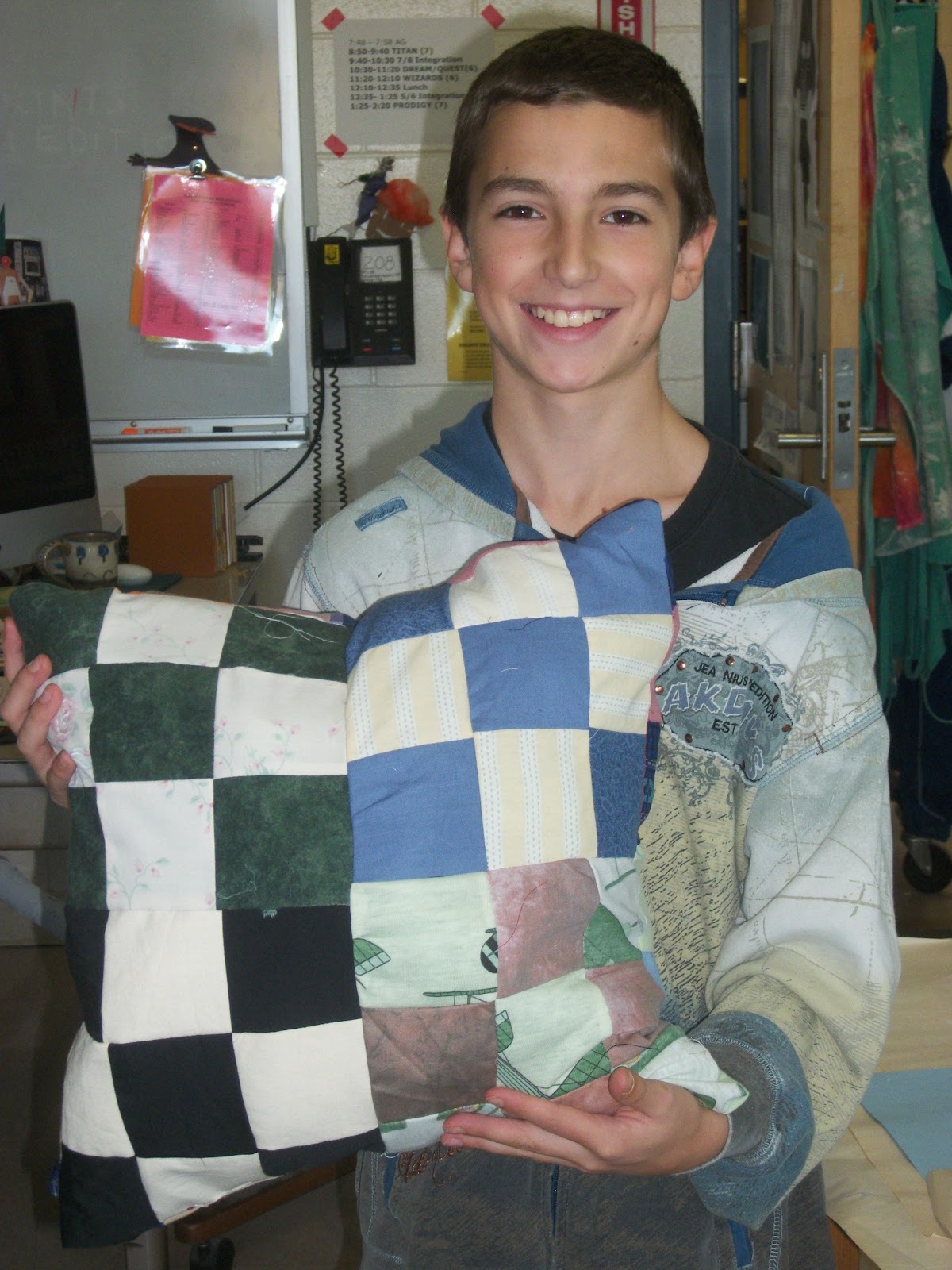
"S", a 6th grader, wanted to try quiltmaking. First he decided on the pattern (9-patch) and the size of each quilt square. I suggested he make a cardboard template so each piece he cut would be uniform in size. We reviewed a running stitch and how to tie a knot, discussed the fact that most quiltmakers sew with a ¼” seam, and he started in.
The first 9-patch was sewn by hand.
Next, I suggested he might want to try the sewing machine.  The next three 9-patches were sewn by machine and assembled into a group of four. The quilt started to look like a good size for a pillow, but time was quickly running out – the quarter was almost over.
I brought in my rotary cutter and cutting mat, and a transparent ruled guide so "S" could cut fabric patches more quickly.  The sewing machine provided its own kinds of lessons, like running out of bobbin thread, necessitating learning how to wind a bobbin.
There are only three more days before the end of the quarter – I’m not sure if the quilt/pillow will be done in time. We are negotiating now for afterschool/recess/study hall time when a few more seams can be sewn and stuffing can be stuffed.
Speaking of stuffing – I was not sure what "S" would use to fill this special pillow – it is quite large by classroom standards, and will take a lot of stuffing.
Last night I an email from a parent: “I am doing some cleanup and I have a bag of new pillow fill that I don't need… Before I throw that away, I thought I should ask you if you can use that fill. If so, I can send the bag to school…”
What luck!
Thanks to the parents who continue to stock the art larder, with all the things that are just what we need!


FINISHED!